
Table of Contents
TogglePicking the right character in Genshin Impact isn’t just about meta tier lists or DPS numbers, it’s about finding a playstyle that clicks with how you actually want to explore Teyvat. That’s where the Vision quiz comes in. Whether you’re a casual player experimenting with different elements or a competitive player optimizing team synergy, understanding which Vision aligns with your gaming personality can transform your entire experience. The seven elements aren’t just mechanical distinctions: they represent different approaches to combat, exploration, and problem-solving. This guide breaks down the Vision system, walks you through the quiz logic, and shows you exactly how to translate your results into a powerful team build that matches both your preferences and the current 2026 meta.
Key Takeaways
- A Genshin Impact Vision quiz matches your playstyle preferences to the right element by assessing combat strategy, team role, and personality traits, helping you build a stronger team aligned with your actual gaming habits.
- Each of the seven Vision elements—Pyro, Hydro, Electro, Cryo, Anemo, Geo, and Dendro—enables different team archetypes and reaction chains; understanding these mechanics helps you leverage your Vision’s full potential.
- Team synergy and elemental reactions amplify damage far beyond raw stats, so your Vision choice determines not just your main DPS but your entire support structure and tactical approach to combat.
- Aggressive players thrive with Pyro and Electro DPS Visions; strategic players excel with Anemo and Dendro support Visions; balanced players benefit from flexible Geo and Hydro Visions that adapt to multiple roles.
- Once matched to a Vision, optimize your build by selecting the correct artifact set, weapon, and talent priorities for your character’s role—then master elemental rotation discipline to extract competitive-level performance.
What Is a Vision in Genshin Impact?
A Vision in Genshin Impact is a crystalline object that represents an elemental affinity granted to a character. Unlike weapons or artifacts that players equip, a Vision is intrinsic to each character’s identity, it defines their elemental attacks, Elemental Skills, and Elemental Bursts. When a character wields a Vision, they gain the power to infuse their attacks with that element, opening up a core mechanic: elemental reactions.
In the lore of Teyvat, Visions are granted by the Archons to mortals who demonstrate a strong desire to pursue their ambitions or ideals. Mechanically, they’re the gateway to advanced combat strategies. A character with a Pyro Vision can trigger Burning reactions with Electro attacks, while a Hydro Vision user can create Vaporize or Freeze combinations. The Vision you align with shapes your entire approach to puzzles, domains, and Spiral Abyss floors. It’s not just flavor, it’s the foundation of how you’ll play.
How the Vision System Works
The Vision system operates on two core mechanics: elemental infusion and elemental reactions. Every character has one Vision, and that Vision determines what element their abilities apply. When a character applies their element to an enemy, that enemy enters an “aura” state. If another character applies a different element while that aura is active, a reaction triggers, and reactions are where Genshin Impact combat becomes a puzzle game.
The system rewards team building over raw stats. A character in isolation may deal decent damage, but pair them with complementary Visions, and you’re multiplying damage output, healing, or utility through reaction chains. This is why understanding the Vision system matters even before the quiz. You’re not picking an element for one character: you’re picking the foundation for a team archetype.
Vision Elements and Their Mechanics
Each of the seven elements, Pyro, Hydro, Electro, Cryo, Anemo, Geo, and Dendro, has unique applications. Pyro deals with burning and overload: Hydro excels at vaporize and freeze setups: Electro triggers aggravate, hyperbloom, and energy batteries: Cryo enables freeze teams: Anemo provides elemental damage bonuses and crowd control: Geo delivers shields and off-field damage: Dendro creates bloom reactions and spread combos.
Mechanically, applying an element multiple times (“stacking”) can intensify reactions. A Dendro character hits an enemy, then a Hydro support applies Hydro multiple times before the Dendro aura fades, this spam triggers bloom repeatedly. The element duration, application frequency, and reaction multipliers vary by character and artifact set, making team composition nuanced. When picking your Vision, consider not just the element itself, but how often and at what intervals you’ll apply it.
Elemental Reactions and Synergy
Elemental reactions are the explosive payoff to strategic Vision pairing. Vaporize multiplies Hydro or Pyro damage by 1.5x (or 2x with certain conditions): Freeze locks enemies in place while boosting Cryo damage: Hyperbloom detonates seeds into massive area damage: Aggravate boosts Electro DPS against enemies with the Electro aura. Not all reactions benefit a character equally, a Cryo main DPS benefits hugely from freeze, while a Hydro support might care more about vaporize setup.
The synergy is bidirectional. If you pick Pyro as your main DPS, you’ll want a Hydro applicator for vaporize. If you pick Hydro, you might want Cryo for freeze or Dendro for bloom support. This is where the Vision quiz guides you: it identifies your combat preference, then recommends elements that naturally enable that playstyle.
The Seven Vision Elements Explained
Understanding each element’s strengths, weaknesses, and playstyle is essential before taking, or interpreting, the Vision quiz. Here’s what you’re choosing between.
Pyro: The Flame Vision
Pyro excels at raw damage amplification through Vaporize reactions. Pair a Pyro main DPS with a Hydro applicator, and you’re triggering 1.5x damage multipliers on every hit. Key mechanics include Burning (damage over time against enemies with Dendro aura) and Overload (AoE knockback with Electro). The playstyle is straightforward: deal high single-target damage, leverage elemental reactions for damage scaling.
Pyro characters are found across the tier list, from five-star powerhouses like Hu Tao and Alhaitham to budget-friendly four-stars like Amber. The appeal is immediacy, you see the numbers, you see the results. If you like direct, in-your-face offense with minimal complexity, Pyro suits you. The downside is utility: pure Pyro teams offer less crowd control and survivability than freeze or tank-focused builds.
Hydro: The Water Vision
Hydro is the most versatile element in the current meta. It triggers Vaporize with Pyro, Freeze with Cryo, Bloom with Dendro, and Hyperbloom with specific setups. Hydro users range from main DPS (Neuvillette, Hu Tao’s best partner Yelan) to off-field supports (Xingqiu, Fischl’s Hydro equivalent). The playstyle depends on team context: you could be the primary attacker or the enabler.
Hydro’s strength is flexibility. A Hydro character fits into more team compositions than most elements. If you’re indecisive or like experimenting with different rosters, Hydro offers that freedom. The catch: you’ll need solid investment in your support cast to maximize reactions. Hydro shines in teams, not in isolation.
Electro: The Lightning Vision
Electro underwent massive buffs in Version 3.0 and remains strong through 2026. The element now excels at energy generation, off-field damage (via Fischl’s Aggravate reactions), and spread/hyperbloom combinations with Dendro. Electro characters serve as batteries (generating energy for the team), off-field DPS, or main DPS in aggravate setups.
The playstyle is technical. Electro reactions require precise positioning and timing. Aggravate wants you to stack ATK and Crit on your Electro applicator: hyperbloom needs EM investment and careful enemy placement. If you enjoy optimization and build crafting, Electro rewards that attention. The payoff is consistent, high damage without relying solely on a single reaction. Plus, Fischl with C6 (constellation 6) remains one of the most efficient DPS-per-Primogem investments.
Cryo: The Ice Vision
Cryo dominates the freeze meta, which has ruled Spiral Abyss since Version 2.0. Pairing Cryo with Hydro locks enemies in place, preventing most attacks. Key mechanics include Shatter (breaking frozen enemies), Melt (Cryo reverse-vaporize for 2.0x multiplier), and freeze itself. Cryo characters often serve as main DPS (Ayaka, Ganyu) or Cryo applicators (Shenhe, Rosaria).
Freeze is the most user-friendly playstyle for casual and competitive players. Frozen enemies can’t attack, meaning survivability is passive. You’re free to focus purely on offense. The tradeoff is that freeze struggles against shielded or freeze-immune enemies (like Cryo-aura bosses). If you value safety and steady, reliable damage, Cryo is your element. The meta has proven freeze’s staying power: it’s been viable for over a year with minimal nerfs.
Anemo: The Wind Vision
Anemo is the support element par excellence. Anemo users don’t trigger reactions directly: instead, they spread elements across enemies and boost elemental damage via the Viridescent Venerer artifact set (4-piece grants 40% elemental damage bonus to the triggering element). Characters like Kazuha, Venti, and Wanderer serve as DPS accelerators, crowd controllers, or both.
Anemo isn’t for everyone. You’re not the primary damage dealer: you’re multiplying someone else’s damage. But that’s precisely why top-tier competitive players build Anemo teams: the multiplicative stacking can exceed direct damage. If you like thinking two steps ahead, enabling your main DPS through support, and watching numbers balloon, Anemo is intellectually rewarding. Venti’s crowd control is particularly overpowered in large-enemy content: Kazuha’s flexibility makes him plug-and-play into almost any team.
Geo: The Earth Vision
Geo is the self-sufficient element. Geo doesn’t react with other elements in the traditional sense, instead, Geo constructs (shields, walls, turrets) provide off-field damage and shields. Geo characters form “mono-Geo” teams that leverage Geo resonance (bonus damage and shields) without relying on elemental reactions. Key mechanics include crystallize (shields from other elements), and Geo-specific combos like Zhongli’s shield + Alhaitham’s off-field Dendro.
Geo suits players who value control and independence. You’re less reliant on reaction chains, more reliant on positioning and timing. Zhongli, the Geo archon, provides the strongest shield in the game, if you want to face-tank bosses, Geo enables that. The playstyle is slower but more deliberate. You’re solving puzzles through construction, not explosive reactions. If you like methodical, puzzle-like combat, Geo resonates with you.
Dendro: The Nature Vision
Dendro is the newest element, introduced in Version 3.0, and it’s transformed the meta. Dendro reactions include Bloom (spawns seeds detonated for massive damage), Hyperbloom (Electro detonates seeds), Burgeon (Pyro detonates seeds), and Spread/Aggravate (Electro and Cryo amplify Dendro damage). Dendro characters are dominantly off-field supports (Nahida, Baizhu) or main DPS (Alhaitham, Hu Tao with Dendro partners).
Dendro is the most flexible element for team building. It works in mono-Dendro teams, Dendro-Electro aggravate, Dendro-Hydro hyperbloom, and Pyro-Dendro burgeon. If you love experimenting with different team configurations and chasing the meta, Dendro offers endless possibilities. The learning curve is steeper, Dendro reactions have unique mechanics, but the payoff is pure optionality. Most top-performing teams in current Abyss contain at least one Dendro character.
Why Take the Vision Quiz?
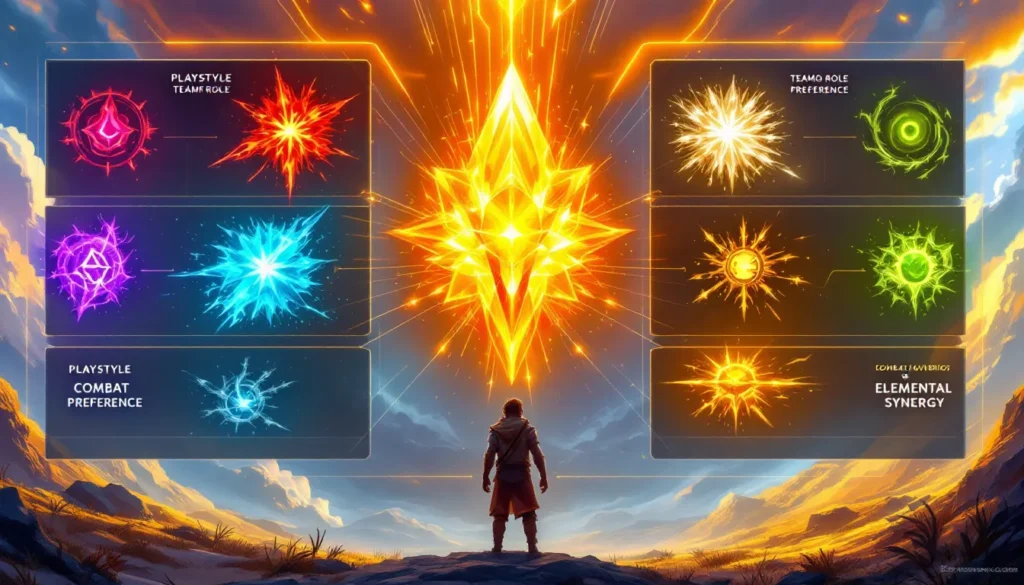
A Vision quiz serves one purpose: to translate your gaming preferences into a concrete element recommendation. It’s not a personality test (though it borrows personality-matching psychology), and it’s not gospel, it’s a starting point for team building.
Discover Your Playstyle Preference
Different players optimize for different things. Some want maximum DPS: others want comfort and survivability. Some love complex team rotations: others want to mash buttons and watch explosions. The Vision quiz surfaces these preferences through targeted questions about combat strategy, exploration style, and team role preference.
If you answer “I like shielding my team and taking hits,” the quiz points toward Geo or Hydro supports. If you answer “I want to one-shot enemies before they act,” it steers you toward Pyro or Electro burst DPS. This discovery phase saves hours of trial-and-error. Instead of trying all seven elements, you’re starting with a vetted recommendation.
The quiz also helps new players understand why certain elements matter. Reading that Cryo enables freeze is abstract: discovering through the quiz that you prefer “preventing enemies from attacking” and getting matched with Cryo makes the connection concrete.
Optimize Your Team Composition
Your Vision quiz result isn’t just about your main DPS, it’s about team archetype. If the quiz recommends Dendro, you’re not just building Dendro DPS: you’re considering Dendro bloom, Dendro hyperbloom, or Dendro spread teams. The quiz then directs you toward optimal supports and off-field enablers.
This matters because raw element strength varies by team context. Pyro is strong with Hydro applicators: weak without them. Electro is strong in aggravate and hyperbloom: weak in pure physical teams. The quiz accounts for these contextual strengths, recommending not just the element, but viable team archetypes built around it. You walk away with a roadmap: here’s your main DPS element, here are the supports that unlock its potential, and here’s why they work together.
For players rebuilding rosters or planning Primogem spending, this is invaluable. You’re not pulling the newest limited five-star because hype says so: you’re pulling because your Vision aligns with your team structure and playstyle.
How to Approach the Vision Quiz
Taking the quiz honestly and thoughtfully yields better results than gaming it or overthinking. Here’s how to extract maximum value.
Answer Honestly About Your Gaming Preferences
Quizzes are useless if you answer based on what you think you should like instead of what you actually enjoy. If you hate freeze teams but answer “I want crowd control,” you’ll get matched with Cryo even though it being wrong for you. Instead, ask yourself: What do I actually do when no one’s watching? Do I min-max damage rotations, or do I wander around exploring? Do I retry Spiral Abyss 20 times to perfect a run, or do I auto-farm domains?
Honesty means admitting preferences you might otherwise dismiss as “inefficient.” If you love playing Geo even though it being less optimal than Dendro, that matters more than meta rankings. The quiz is a guide, not a judgment. The best Vision is the one you’ll actually invest in and play.
Consider Personality Traits and Archetype Matching
Vision quizzes often blend playstyle questions with personality questions. This isn’t arbitrary, it’s because playstyle and personality correlate. Aggressive players gravitate toward high-damage, high-risk elements like Pyro and Electro. Defensive players prefer Cryo freeze (safe, predictable) or Geo shields (tanky). Creative players thrive with Anemo (flexibility) or Dendro (complex reactions).
When the quiz asks “How do you handle pressure?” or “What’s your ideal team role?” it’s building a profile. Your answer to “Do you prefer leading or supporting?” directly maps to main DPS versus support elements. These correlations improve recommendation accuracy. You’re not just picking an element: you’re picking one that meshes with how you approach challenges.
Don’t skip or randomize personality questions. They carry weight.
Think About Combat Roles You Enjoy
Genshin Impact has five combat roles: main DPS (primary attacker), sub-DPS (secondary attacker), off-field DPS (passive damage while benched), support (buffs/heals), and enabler (triggers reactions without dealing direct damage). Most players prefer one or two roles.
If you love being on-field, attacking constantly, the quiz should steer you toward viable main DPS elements: Pyro, Hydro, Electro, Cryo, or Dendro. If you’re off-fielding, you care about energy generation and passive damage: Anemo, Electro, Dendro, or Hydro supports. If you’re enabling teams through reactions, you’re likely Hydro or Dendro support.
When answering, translate your favorite game moments into role language. If you remember loving Kazuha’s burst that buffed your team’s damage, you enjoy off-field support and enabler roles, point the quiz toward Anemo or flexible supports. If you remember one-shotting a boss with Ganyu’s burst, you love main DPS, point toward Cryo or Pyro. The quiz interprets these patterns and recommends accordingly.
Matching Your Quiz Result to Top-Tier Characters
Your Vision quiz result points to an element: your next step is finding characters within that element who match your budget, playstyle, and current roster. Not all Pyro characters are identical, and matching result to character requires a second layer of analysis.
Popular Characters by Element
Each element has marquee characters dominating the meta in 2026. Pyro boasts Hu Tao (single-target vaporize DPS), Alhaitham (off-field Dendro applicator), and Lyney (newest limited five-star). Hydro includes Neuvillette (premier main DPS), Yelan (universal off-field sub-DPS), and Xingqiu (free, starter-friendly applicator). Electro features Fischl (best off-field DPS per Primogem), Nahida (though technically Dendro, she synergizes with Electro), and Raiden Shogun (burst DPS + battery).
Cryo is ruled by Ayaka and Ganyu (both top-tier main DPS), alongside Shenhe (Cryo buffer). Anemo has Kazuha (flexible sub-DPS), Venti (crowd control), and Wanderer (main DPS). Geo features Zhongli (universal shielder, not a DPS) and Alhaitham (off-field Dendro). Dendro is anchored by Nahida (off-field applicator) and Alhaitham (on-field main DPS). Resources like Game8 provide tier lists and build guides if you’re searching for current meta rankings.
Your quiz result narrows this pool. If you’re matched with Cryo and your quiz indicates you enjoy main DPS roles, you’d lean toward Ayaka or Ganyu. If you prefer support roles, you’d build around Shenhe or Rosaria as enablers. The element guides direction: your playstyle preference refines it further.
Building Teams Around Your Vision
Once you’ve identified a character, the next step is assembling the team that maximizes their potential. This is where understanding elemental synergy becomes critical. In the Genshin Impact Archives, you’ll find detailed team compositions for virtually every viable main DPS.
Let’s say your quiz result is Hydro, and you choose Neuvillette as your main DPS. You’re not just grabbing any three supports, you’re building specifically for his mechanics. Neuvillette wants an off-field Dendro applicator (Nahida, Baizhu), a healer (Bennett, Barbara), and possibly a Cryo applicator (Shenhe, Rosaria) to enable freeze reactions on smaller enemies. Each support slot has a tactical purpose.
Alternatively, if your result is Pyro and you choose Hu Tao, you’re building for vaporize: Hydro applicator (Xingqiu, Yelan), healer (Bennett, Zhongli for shield), and flex sub-DPS (Fischl, Kazuha). Different Vision, different team logic, but the principle is identical. Your Vision defines the team archetype: your character archetype (main DPS, sub-DPS, support) fills the remaining slots.
Your quiz result provides the framework. From there, it’s about matching available characters to that framework and optimizing for your current resources.
Common Vision Quiz Archetypes and What They Mean
Most Vision quizzes bucket players into three broad archetypes, then refine toward specific elements. Understanding these archetypes helps you contextualize your result.
The Aggressive Damage Dealer
This archetype prioritizes offense: highest personal DPS, burst windows, glass-cannon builds. Aggressive players willingly sacrifice defense for damage multipliers. They enjoy high-risk, high-reward gameplay and optimize for Crit Rate, Crit DMG, and ATK stats above all else. In team selection, they prefer main DPS roles with strong on-field presence.
Aggressive archetypes typically match to Pyro, Electro, or Cryo main DPS. These elements offer direct damage scaling and explosive reaction multipliers. Hu Tao (Pyro), Fischl (Electro off-field with potential Aggravate), and Ayaka (Cryo) are quintessential matches. The quiz recognizes aggressive responses (“I want the highest numbers,” “I retry tough fights until I perfect them”) and steers accordingly.
If you receive this result, your Vision is a DPS Vision. You’re expected to be on-field, and your team revolves around enabling your damage. This demands good artifact rolls, weapon investment, and macro timing, you’re carrying your team’s offense.
The Strategic Support Player
This archetype values team enablement, buffs, and multiplicative damage. Strategic players enjoy rotating between characters, managing energy, and setting up burst windows. They’re fine dealing modest personal damage if it means buffing allies to astronomical levels. They optimize for EM (Elemental Mastery), ER (Energy Recharge), and utility stats over raw Crit.
Strategic archetypes match to Anemo, Dendro, or Hydro supports. Kazuha amplifies allies’ damage through Elemental DMG bonuses. Nahida enables Dendro reactions across teams. Xingqiu chains vaporize for your main DPS. The quiz catches strategic responses (“I love team rotations,” “I enjoy complex reactions”) and recommends accordingly.
If you receive this result, your Vision is a support Vision. You’re orchestrating the team’s offense even if you’re not the primary attacker. This demands different build priorities, ER and EM over Crit, and rotation knowledge. You’re the team architect.
The Balanced All-Rounder
This archetype sits between offense and defense, enjoying both personal damage and team utility. Balanced players want flexibility, capable of being on-field, benched, or hybrid depending on team needs. They’re comfortable with mixed stat priorities and appreciate characters that work in multiple roles.
Balanced archetypes often match to Geo, Hydro, or flexible Dendro characters. Zhongli shields and provides universal shred (debuff). Fischl deals off-field damage while enabling teammates. The quiz identifies balanced responses (“I want flexibility,” “I like characters that work in multiple roles”) and recommends accordingly.
If you receive this result, your Vision is a flex Vision. You can build your character as on-field DPS or off-field support depending on team needs. This offers the most team-building freedom but demands deeper understanding of energy rotations and stat balancing. You’re generalist, not specialist, and that’s powerful in dynamic content like Spiral Abyss with rotating enemy lineups.
Tips for Maximizing Your Vision’s Potential
Your Vision quiz result is a starting point, not an endpoint. Once you’ve matched your result to a character and assembled a team, you’re entering the optimization phase. This is where raw element knowledge transforms into practical builds.
Weapon and Artifact Selection
Weapon choice is the first decision tier. Most Visions have signature weapons (limited five-star weapons designed for specific characters) and viable craftable/gacha alternatives. A Pyro DPS like Hu Tao uses Staff of Homa (signature) or Dragon’s Bane (gacha) or Blackcliff Pole (shop). Each weapon adjusts stats and passive effects, changing your build math.
Artifact selection is layered. Every Vision benefits from certain artifact sets based on reactions and playstyle. Pyro DPS benefits from Crimson Witch of Flames (boosts Pyro damage and Overload/Burning). Cryo DPS benefits from Blizzard Strayer (boosts Cryo damage and freeze bonus). Dendro off-field applicators benefit from Gilded Dreams (boosts EM and team EM). The artifact set is non-negotiable, using the wrong set tanks your damage by 30-50%.
After weapon and artifact set, you’re optimizing substats. Main stat distribution (HP%, ATK%, EM, ER%, Crit Rate, Crit DMG) varies by character role. A Pyro main DPS wants ATK% main stat with Crit substats. A Cryo freeze applicator wants ER% main stat with EM and Crit substats. Resources like RPG Site maintain updated build guides for every character detailing optimal weapon and artifact combinations.
The key is alignment: weapon, artifacts, and substats should reinforce your Vision and character’s role. Misalignment (e.g., stacking EM on a pure DPS with no reaction support) wastes investment.
Leveling Talent Priorities
Each character has three talents: Normal Attack, Elemental Skill, and Elemental Burst. Leveling all three is expensive (requiring specific material drops): most players prioritize two.
Priority depends on role. A main DPS prioritizes Normal Attack and Elemental Burst (both deal direct damage). An off-field sub-DPS prioritizes Elemental Skill and Burst (they’re off-field, so Normal Attack is wasted). A support prioritizes Burst and Skill (for scaling buffs/heals). Your Vision quiz result influences role: role determines talent priority.
Also, certain talents have higher scaling multipliers than others. Hu Tao’s Elemental Skill has 385% multiplier at Talent 9: her Normal Attack has lower multiplier. Prioritizing Skill over Normal Attack aligns with her kit design. Understanding your character’s kit, which talents scale highest, which interact with your element, is critical.
Leveling priority also considers cooldowns. If a character’s Elemental Skill has a 4-second cooldown and your Burst has a 20-second cooldown, leveling Skill first generates more damage over time. This requires reading your character’s details on sites like Game8 or in-game descriptions.
Mastering Elemental Combo Strategies
Finally, the meta layer: understanding your element’s reaction chains and how to trigger them consistently. This is where Genshin Impact transitions from action game to puzzle game.
For Pyro DPS with Hydro applicator, you’re managing Hydro aura duration. Xingqiu applies Hydro four times per burst: if your Pyro attacks land faster, you’re wasting applications (DPS loss). Pacing your attacks to consume exactly four Hydro auras before reapplication maximizes vaporize triggers. This is subtle but crucial.
For Dendro teams, you’re managing Dendro cores. Nahida applies Dendro off-field: Hydro applicators spawn cores: Electro applicators detonate them into blooms. You want cores spawning at consistent intervals without clogging the field (too many cores reduce DPS). This demands EM investment, energy management (ensuring Nahida’s burst is up when cores spawn), and positioning (keeping Electro applicators close to core clusters). The Genshin Impact Main guide covers foundational team building: advanced resources focus on this rotation layer.
Mastering combos means studying frame data (attack/cast frame timing), understanding ICD (Internal Cooldown, how often an ability applies an element), and practicing rotation discipline. This is where casual and competitive diverge. Casual players enjoy the element: competitive players extract maximum value through optimization.
Conclusion
The Genshin Impact Vision quiz isn’t a personality test masquerading as game advice, it’s a decision framework designed to align your playstyle preferences with mechanical reality. By answering honestly about your combat preferences, team roles, and personality archetype, you’re getting matched to an element that unlocks enjoyment and efficiency simultaneously.
Your result points toward specific characters, team compositions, and build strategies. From there, the optimization path is clear: select the right weapon, farm the right artifact set, level the right talents, and practice the right rotations. This progression from quiz result to competitive team is what separates casual exploration from serious Spiral Abyss pushes.
Whether you’re a new player discovering your element or a veteran looking to rebuild your roster, the Vision quiz serves as a compass. The meta will shift, new characters release, patches rebalance reactions, and strategies evolve. But your fundamental playstyle preference remains constant. Pick an element aligned with how you want to play, build around it intentionally, and you’ve set yourself up for long-term enjoyment in Teyvat. The quiz is just the first step: from there, it’s about executing the build and mastering the mechanics.


